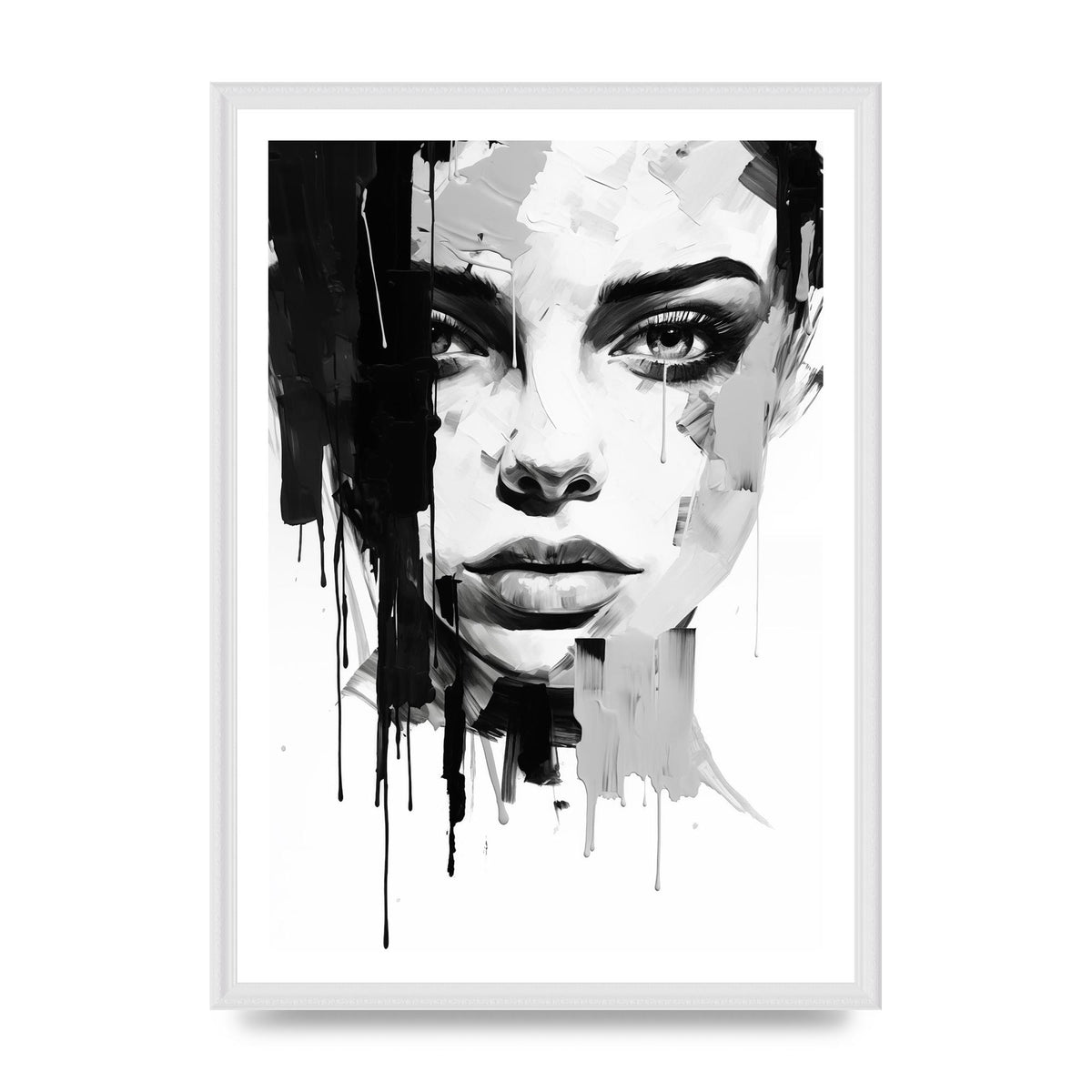
Minimalist Black and White Portrait
Minimalist Black and White Portrait
Creating an abstract minimalist portrait in black and white involves simplifying facial features into basic shapes and lines, focusing on minimalistic design principles. This style emphasizes simplicity and abstraction, stripping away unnecessary details while conveying the essence of the subject.
Read more
To begin, select a reference photo of a person or choose a subject to envision in your mind. Next, start by sketching the basic outline of the head and facial proportions using simple geometric shapes like circles or ovals. Avoid adding intricate details such as individual strands of hair or facial contours.
Instead of depicting specific facial features, consider reducing them to basic shapes. For example, the eyes can be represented by simple ovals or circles, while the nose could be simplified to a small triangle or an inverted V shape. The mouth might be reduced to a horizontal line or a small curve.
Lines play a crucial role in minimalist portraits. Use straight, clean lines to represent the edges and contours of the face, emphasizing simplicity over complexity. These lines can outline the shape of the head, define the eyes, and create a sense of structure in the drawing.
To enhance the minimalistic effect, limit the number of shades used. Stick to a black and white palette and focus on the interplay between light and dark areas on the face. Experiment with shading techniques such as hatching or cross-hatching to add depth while maintaining the simplicity of the overall composition.
Remember that the goal of an abstract minimalist portrait is not to create a hyper-realistic representation; rather, it is to convey the essence and character of the subject through simplified forms. The end result should be a striking, reduced depiction that captures the viewer's attention through its minimalism and unique interpretation of the subject.
Size guide
Size guide
All our prints are made to standard A sizes. The measurements below are the picture size — the printed image area. If you choose a framed option, the frame sits around this area, so the finished piece on your wall will be a little larger.
| Size | Centimetres | Inches |
|---|---|---|
| A4 | 21 x 29.7 cm | 8.3 x 11.7 in |
| A3 | 29.7 x 42 cm | 11.7 x 16.5 in |
| A2 | 42 x 59.4 cm | 16.5 x 23.4 in |

Couldn't load pickup availability